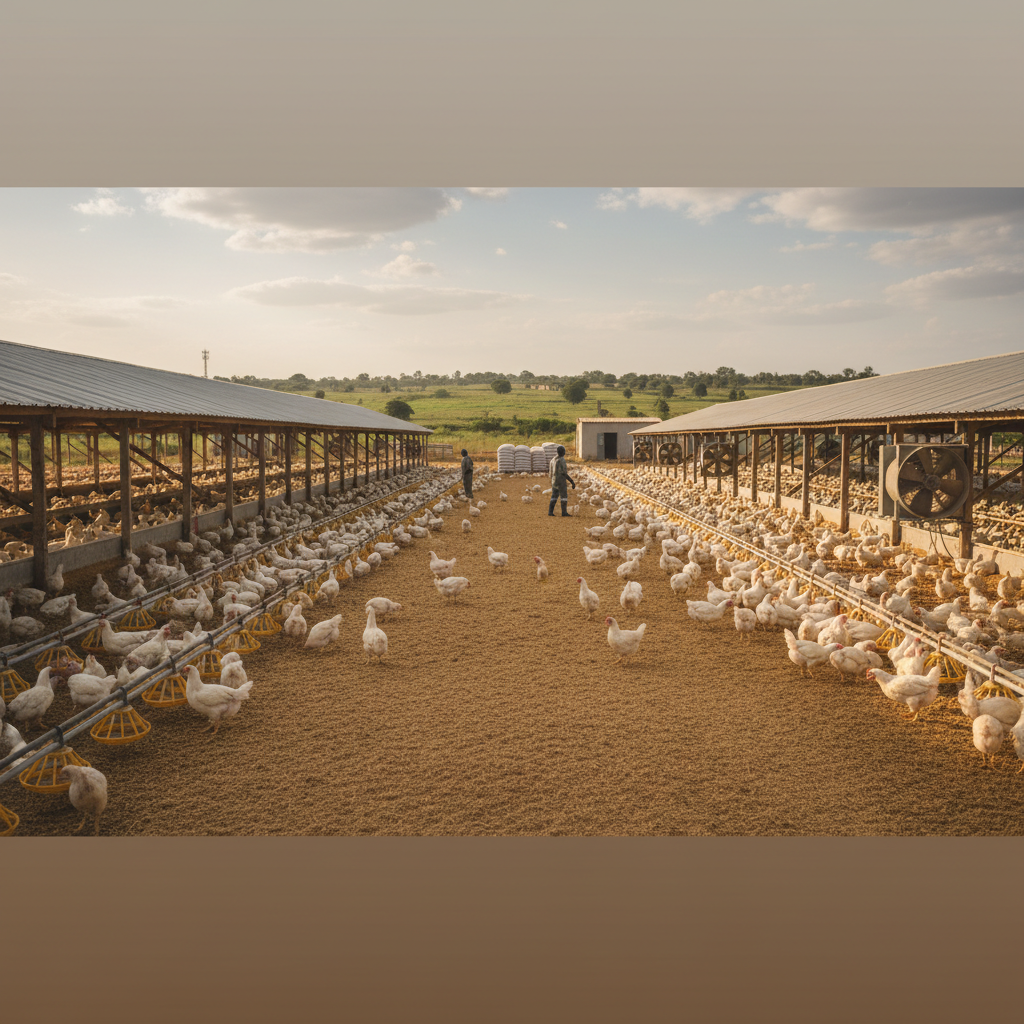
Ghana will now commercialize its poultry industry following the successful first phase of the government's Nkoko Nkitinkiti Programme. The initial phase focused on household poultry production and has enabled the Ministry of Food and Agriculture to proceed with large-scale commercial operations.
Minister for Food and Agriculture, Eric Opoku, announced this development after briefing Parliament. He stated that the strong public response and positive outcomes from the household phase have given the government confidence to expand. This expansion aims to build a self-sustaining poultry industry in Ghana.
This initiative fits into Ghana's broader economic strategy to reduce import dependency and stimulate local production. Ghana currently relies heavily on imported frozen chicken. The programme seeks to retain more value within the local economy and strengthen food security. This aligns with government efforts to revitalize rural economies and create employment opportunities, especially for women and young people.
Mr. Eric Opoku confirmed that the first phase showed Ghanaian households are ready to rebuild the country's poultry industry. He described the programme as a long-term strategy beyond a simple agricultural intervention. It aims to transform the sector, create jobs, and improve household nutrition.
The transition to commercial production will stimulate investments across the entire poultry value chain. This includes hatcheries, feed production, processing plants, and cold-chain logistics. It also covers packaging, transportation, and retail distribution for poultry products. This comprehensive approach ensures support for the industry from farm to market.
The Minister stressed that this programme is a key part of the government's import substitution agenda. Import substitution aims to replace foreign goods with locally produced alternatives. This will help Ghana save foreign currency and reduce its trade deficit. The country spends significant amounts on importing poultry products annually.
Mr. Opoku expressed optimism that the commercialisation phase will mark a turning point for Ghana's poultry industry. He expects it to reduce the country's heavy reliance on imported chicken substantially. The success of the initial phase provides a strong foundation for a competitive poultry industry. Such an industry can drive industrial growth and economic resilience.
The government's commitment to this program reflects a strategic shift towards agricultural self-sufficiency. This move has potential to create thousands of jobs, boosting the income of many Ghanaians. It also promises a more stable food supply for the nation. Decision-makers and markets will closely watch the implementation of this second phase. Its success could signal a broader trend in Ghana's agricultural policy.