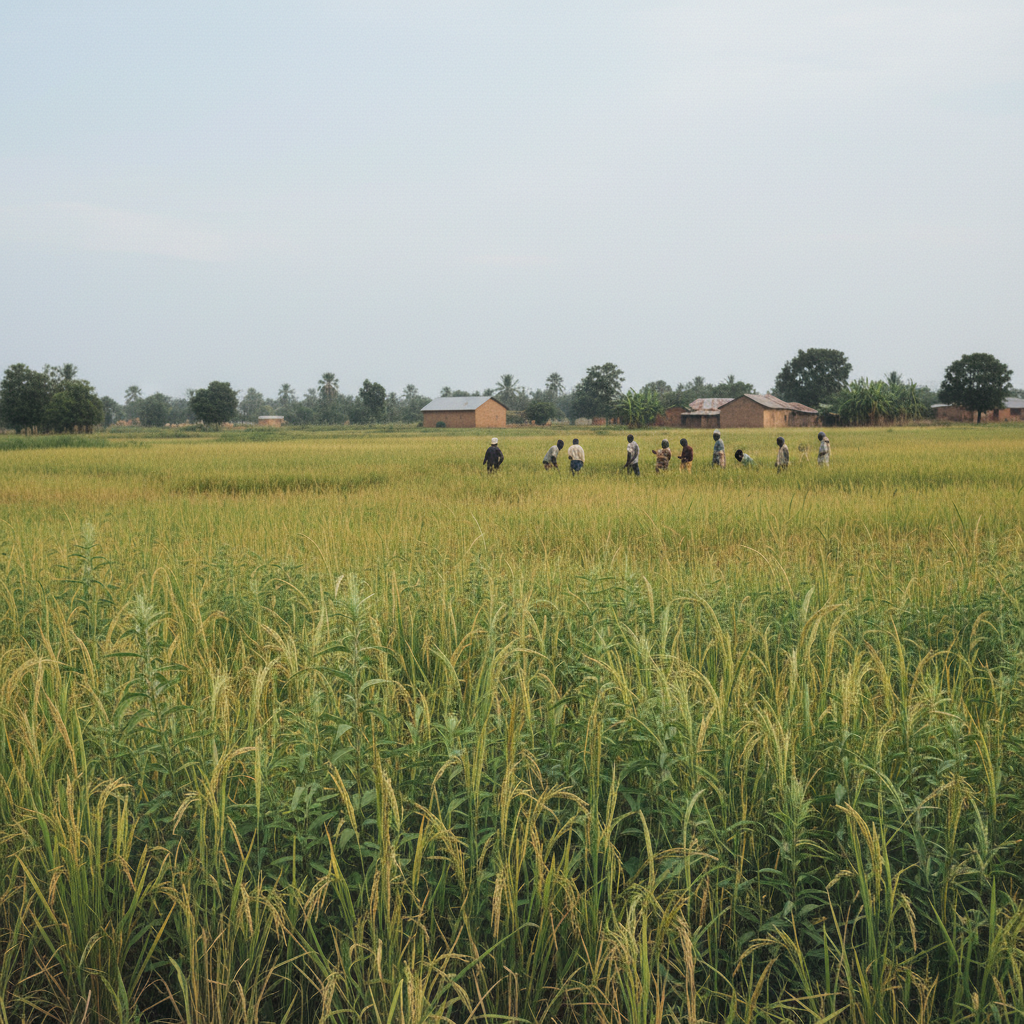
Ghana’s rice farmers are losing as much as 84 percent of their harvests to invasive weeds. This alarming figure was revealed by research from the Council for Scientific and Industrial Research (CSIR-Crops Research Institute, or CSIR-CRI) and the Korea Partnership for Innovation of Agriculture (KOPIA).
These significant crop losses highlight a growing threat to Ghana's food security. Invasive weeds are severely reducing the amount of rice available for consumption, affecting farmers' incomes and the nation's ability to feed its population. The issue requires coordinated national action to protect a vital agricultural sector.
This problem fits into Ghana’s broader economic challenge of achieving food self-sufficiency and reducing reliance on food imports. Rice is a staple food in Ghana, and consistent high losses directly impact food prices and household budgets. Current data indicates that Ghana imports a substantial portion of its rice, making local production vital for economic stability.
Dr. Stephen Arthur, Project Coordinator at CSIR-CRI, stated that farmers are spending GHS 1,600 to GHS 2,000 per acre on manual weed removal. He described this cost as “unsustainable,” emphasizing the financial strain on farmers. He urged the adoption of integrated weed management, which combines timely herbicide use with improved farming methods.
The current situation poses significant implications for Ghana’s agricultural policy and economic planning. The National Food Buffer Stock Company (NAFCOS) may need to adjust strategies for purchasing local produce. Decision-makers must consider policies that support farmers in adopting more efficient weed control methods. This includes providing access to appropriate herbicides and training in modern agronomic practices.
Scientists identified five major weed species that infest Ghanaian rice fields. These include Echinochloa spp., known locally as “Ashaiman killer,” and Leptochloa chinensis, called “Black Jerry.” Urochloa humidicola, or “Aguda,” Ischaemum rugosum, or “Ogo,” and Cyperus spp., known as “Atadwe,” are also prevalent. These weeds can cut yields by 50 to 80 percent and also carry destructive rice diseases.
Pathologist Dr. Atta Aidoo linked the increasing weed infestations to a rise in rice diseases. These include blast, sheath blight, and brown spot. Entomologist Dr. Kofi Frimpong-Anin observed shifts in pest dynamics due to the same weed presence. Agronomist Mr. Kofi Lelabi Kota further studied the competition between crops and weeds. He also analyzed the financial costs of current weed control methods.
Senior CSIR officials are appealing for stronger government support to address this crisis. Prof. Marian Dorcas Quain, Deputy Director-General, highlighted the importance of backing local seed production. This measure would reduce the country's reliance on risky imported rice seeds. Prof. Maxwell Darko Asante, Director of CSIR-CRI, urged the National Food Buffer Stock Company to buy Dawhenya's seeds to ensure progress.
The KOPIA Rice Weed Management Project aims to find sustainable solutions to protect Ghana’s rice sector. Dr. Young Jin Kim, Director of KOPIA Ghana Centre, reiterated Korea’s commitment to building strong rice systems. He pledged continued partnership to support Ghanaian farmers. Farmers who participated in a recent workshop expressed readiness to implement recommended strategies in the next planting season.