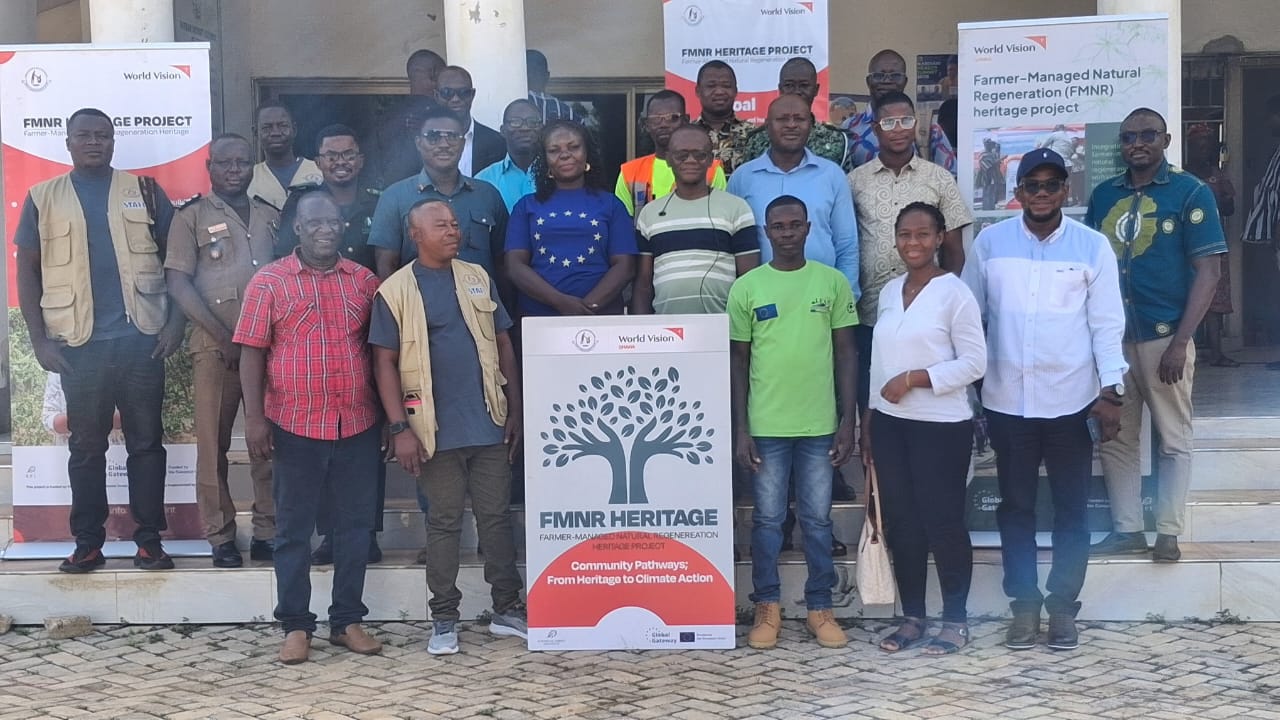
Stakeholders in Ghana's Nabdam District have called for the expansion of a two-year indigenous land restoration project. They seek to cover more communities and provide alternative livelihood opportunities to residents. This aims to sustain gains made in restoring degraded lands across the district.
The project, named “Farmer-Managed Natural Regeneration (FMNR) Heritage,” is currently implemented by World Vision Ghana and the Centre for Community Development Initiatives (CODI). The European Union funds this initiative through the Sustainable Forest and Cocoa Programme. It aims to restore 1,500 hectares of degraded land and improve climate resilience. The project expects to benefit more than 10,000 people, including women, youth, and vulnerable groups.
This call for expansion aligns with Ghana's broader economic strategy to promote sustainable development and climate resilience. The government has emphasized green initiatives and local economic diversification. Such projects reduce reliance on traditional, often environmentally damaging, practices. They also support rural economies by creating new income streams.
Mr. Francis Tobig, the Nabdam District Chief Executive, highlighted the importance of providing alternative livelihoods. He stated that residents depend on current activities for survival. Restricting their movement within forest zones requires offering viable economic alternatives. This ensures community buy-in and long-term success for environmental efforts.
The expansion would include interventions like irrigation, dry-season farming, fish farming, and agro-processing. These activities would reduce communities' dependence on practices contributing to environmental degradation. Decision-makers will now consider these proposals. The success of such integrated approaches could serve as a model for other districts facing similar environmental and economic challenges.
Ms. Patience Padikie Olesu-Adjei, the Programme Manager for Natural Resources at the EU Delegation to Ghana, visited the district to assess the project. She expressed satisfaction with community engagement. Ms. Olesu-Adjei assured stakeholders that their concerns would be relayed to relevant authorities for consideration. This indicates potential for further EU support and collaboration.
Mr. Rasheed Imoro, the Nabdam District Director of Agriculture, advocated for small-scale irrigation solutions. He suggested boreholes, solar-powered pumping systems, and storage tanks. These would support dry-season vegetable farming, providing regular income for farmers. This approach is more cost-effective than large-scale irrigation schemes.
Mr. Michael Mannor, the Nabdam Forest Range Manager, noted the project's alignment with the government’s Tree for Life reforestation initiative. The project has already distributed seedlings to schools. Using indigenous tree species adapted to the local environment is crucial for successful restoration efforts.
Mr. Rexford Bugre, Northern Operations Manager for World Vision Ghana, emphasized the role of alternative livelihoods in successful re-greening efforts. Household-level processing and dry-season gardening have shown potential for income generation. He called for extending the project's geographical coverage and duration.
The project has already trained 865 farmers in Farmer-Managed Natural Regeneration approaches. It has mapped out 264.6 hectares of degraded lands for restoration. This demonstrates significant progress and the potential for wider impact with increased investment and scope.