Ghana is preparing to give the Ghana National Petroleum Corporation (GNPC) a more commercially assertive role in the country’s upstream petroleum industry. This move aims to strengthen energy security, revive exploration investment, and reduce the economy’s exposure to expensive imported fuels. GNPC will now take larger commercial interests and deepen its involvement across the petroleum value chain.
Mark Prempeh of the Ministry of Energy and Green Transition confirmed this policy direction. He stated that GNPC would no longer remain a minority participant in oil and gas projects. The government sees GNPC as capable of retaining a larger share of commercial value from Ghana’s petroleum resources. This also strengthens the country’s strategic control over energy supply.
This policy represents a significant shift in the government’s approach to the national oil company. Historically, GNPC participated alongside international operators. The new strategy positions GNPC to secure more commercial value and protect domestic interests. This is especially important when international investors change strategies or exit assets.
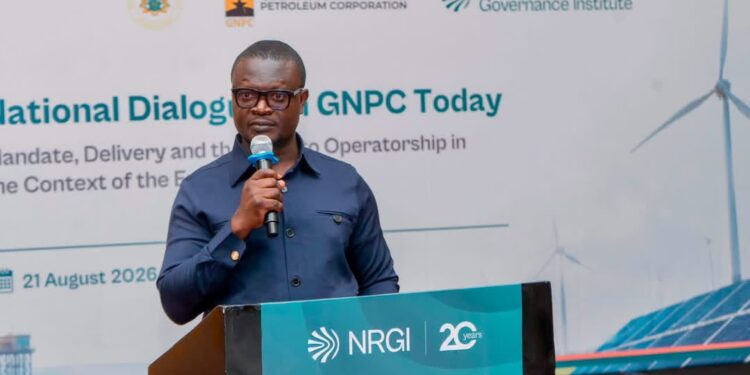
Mr. Prempeh made these remarks at a National Stakeholder Engagement. The event, titled “GNPC Today: Mandate, Delivery, and the Road to Operatorship in the Context of Energy Transition,” was jointly convened by GNPC and the Natural Resource Governance Institute. He emphasized that deeper participation is necessary for Ghana to have a national institution capable of protecting its interests. “When everybody else leaves, GNPC succeeds,” Mr. Prempeh stated, highlighting the long-term vision.
Taking larger commercial stakes will require GNPC to mobilize significantly more capital. This capital is needed for exploration, appraisal, and field development activities. This increased involvement also exposes the corporation more directly to geological uncertainty and commodity-price volatility. Project execution risk will also rise for GNPC.
The government’s position comes at a challenging time for Ghana’s upstream industry. Crude production from existing fields has been under pressure. Competition for global exploration capital has also intensified. The global energy transition further complicates investment decisions for long-cycle hydrocarbon assets.
For GNPC, the challenge is two-fold. It must build the technical and financial capacity required for operatorship. Simultaneously, it must ensure that expansion does not weaken its balance sheet. The corporation must also avoid transferring disproportionate commercial risk to the state. Gas commercialization sits at the centre of this strategy.
Mr. Prempeh highlighted GNPC’s critical role in supplying gas to Ghana’s power sector. The government seeks to reduce dependence on more expensive liquid fuels used by thermal power plants. “GNPC plays a key role in our gas commercialisation drive, actually providing us with the gas,” he explained. Replacing liquid fuels with gas for thermal plants will reduce the cost of power generation.
Greater use of domestic gas in thermal generation offers several benefits. It could reduce demand for imported liquid fuels, easing pressure on foreign exchange reserves. It would also lower the cost of electricity generation for consumers and businesses. This could also improve the commercial attractiveness of upstream gas projects. A more predictable domestic market for both associated and non-associated gas would emerge.
Alongside GNPC’s stronger role, the government is pursuing a fiscal and regulatory “reset.” This aims to make Ghana more competitive for upstream investment. “We believe that we have to be competitive. As a nation, we have to be competitive in the market,” Mr. Prempeh asserted. Ghana competes with other African and global petroleum provinces for scarce upstream capital.
Fiscal terms that are too burdensome can undermine project economics and push investment elsewhere. However, excessive concessions can reduce the state’s share of future petroleum revenues. The government must design a framework that improves investor returns without surrendering too much economic rent from commercially viable discoveries. This delicate balance is crucial for attracting the right investors and ensuring Ghana benefits from its resources.