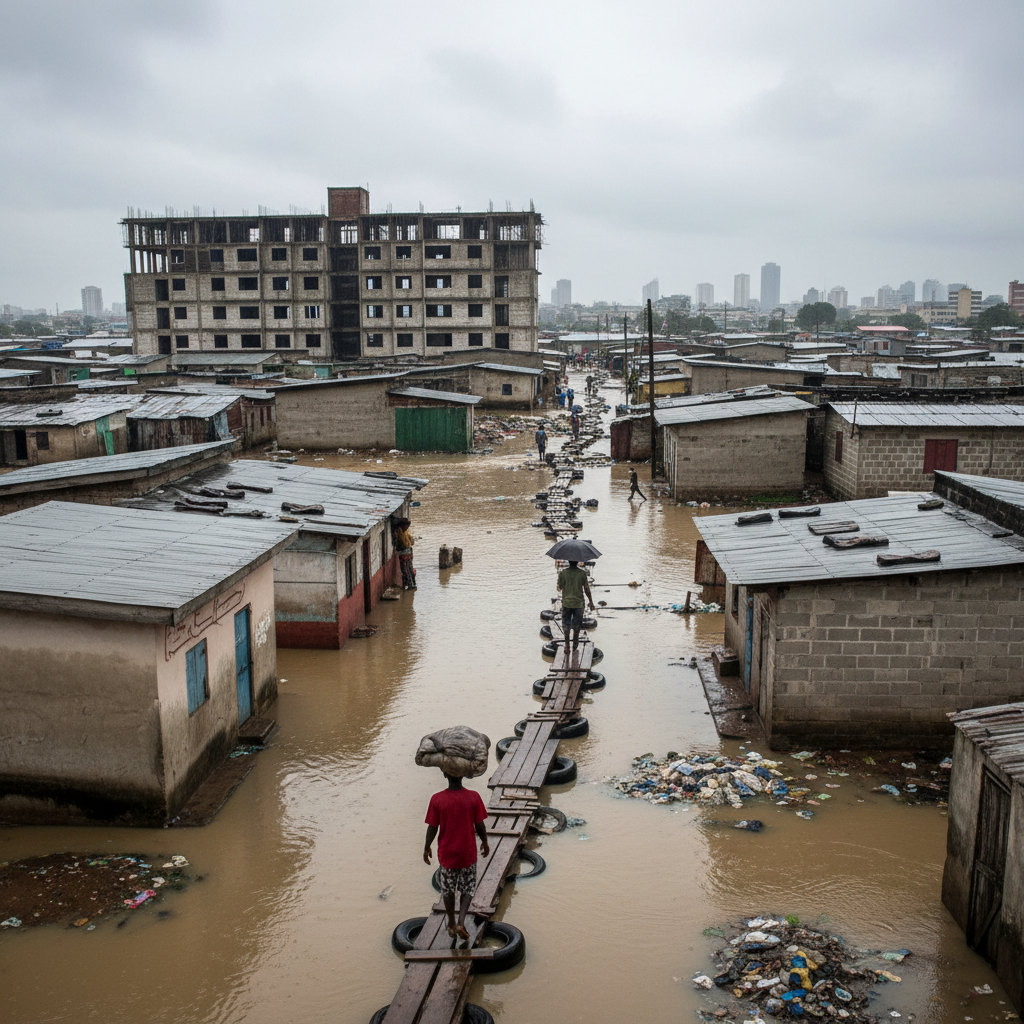
Accra's recurring floods are primarily a result of urban governance failures, not simply heavy rainfall. These systemic issues include inadequate drainage, unregulated building in flood-prone areas, and a lack of coordination among responsible institutions.
The city's rapid expansion, from 400,000 residents in 1957 to 5.5 million today, has overwhelmed its existing infrastructure. This population surge led to extensive, often unregulated, construction in natural drainage paths, increasing the city's vulnerability. Low-income communities, particularly in areas like Kaneshie and Alajo, bear the brunt of flood damage and displacement.
This ongoing crisis fits within a broader Ghanaian narrative of urban planning challenges and infrastructure deficits. Despite the Land Use and Spatial Planning Act (2016) providing a framework for development control, its implementation remains weak. This situation reflects a persistent challenge where legislative intent often does not translate into operational reality due to resource constraints and political interference.
According to research highlighted by JoyNews Online, the city's vulnerability is well-documented. Nkrumah et al. (2014) established that while rainfall intensity has increased, the main cause of flood damage is inadequate drainage and land use changes. They identified drainage infrastructure maintenance as the most impactful intervention to reduce flood damage.
Addressing Accra's flooding requires a fundamental shift from emergency management to institutional reform. Decision-makers must focus on enforcing existing planning laws, adequately funding drainage maintenance, and fostering better inter-agency collaboration. Failure to do so will see the cycle of disruption, property loss, and potential fatalities continue each rainy season, with significant economic and social consequences for Ghana.
The primary drivers of this crisis are threefold. First, land use planning has failed consistently. Building permits are often issued for flood-prone zones, and enforcement of development controls is severely under-resourced. Regulatory bodies lack the operational capacity and political support needed to uphold spatial planning frameworks.
Second, drainage infrastructure governance is inadequate. Accra's formal drainage system, managed by the Accra Metropolitan Assembly and the Department of Urban Roads, is poorly maintained and insufficient for the city's current size. The Odaw drain, a critical channel, has seen decades of studies but little sustained improvement.
Third, institutional coordination is lacking. Flood risk management involves many agencies, but their efforts are often poorly coordinated. This fragmentation prevents a unified, effective response to the problem.
Therefore, key stakeholders, including metropolitan assemblies, urban planners, and government bodies, must prioritize a comprehensive strategy. This strategy should include upgrading and maintaining drainage systems, strictly enforcing land-use regulations, and improving cross-institutional communication. Such actions are crucial to mitigating the significant economic damage and human suffering caused by annual floods.
The economic implications are substantial, including property damage, disrupted commerce, and public health risks. Investor confidence and urban development are also negatively affected by the perception of a city unable to manage basic infrastructure challenges. Sustained political will and adequate financial allocation are vital for a lasting solution.