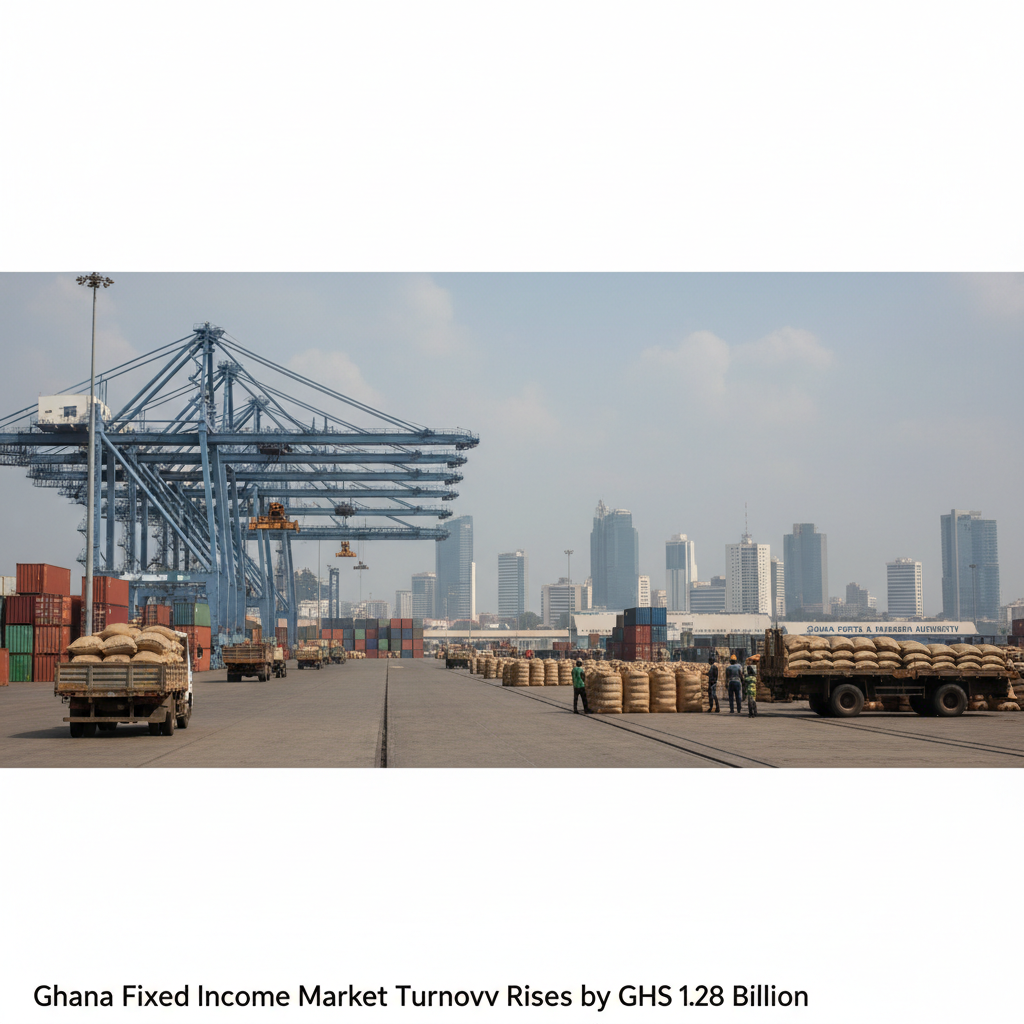
Ghana’s fixed income market experienced a sharp increase in trading activity for the week ending July 10, 2026. Total turnover rose by GHS 1.28 billion, reaching GHS 7.30 billion. This jump from GHS 6.03 billion in the previous week represents a 21.20% increase.
The growth in market activity was primarily due to increased investor engagement in Domestic Debt Exchange Programme (DDEP) bonds and Treasury bills. DDEP bonds alone contributed GHS 3.75 billion to the turnover, a 53.65% increase from the prior week. This surge highlights stronger liquidity in the market, even with a strong concentration on government securities.
This performance fits into Ghana's ongoing economic narrative of financial market adjustments following the DDEP. The programme saw bondholders exchange existing government bonds for new ones with different terms. The market's strong focus on government securities, which accounted for 97.87% of total activity, underscores their continued dominance. While Treasury bills remain attractive for their short maturities, the robust DDEP bond activity shows investors are actively engaging with restructured instruments.
According to the Norvan Reports' GFIM Wrap for July 6 to July 10, DDEP bonds comprised 51.36% of the total weekly turnover. Treasury bills followed closely with GHS 3.40 billion in trades, making up 46.51% of market activity. The report suggests that investors are balancing short-term liquidity needs with a renewed interest in medium- and longer-dated instruments.
Going forward, attention will focus on how this increased activity influences the yield curve, particularly for longer-dated DDEP bonds. Decision-makers will observe whether this trend represents sustained investor confidence or short-term positioning. The market’s continued reliance on government securities also raises questions about developing a deeper corporate bond market in Ghana.
Within the DDEP bond segment, the 9-year DDEP instrument led with GHS 1.36 billion in turnover. The 11-year DDEP bond followed, recording GHS 964.80 million in trades. These figures suggest investors are not only seeking shorter-duration instruments but are also willing to invest in longer maturities offering attractive yields. This preference may stem from expectations that inflation and interest rates will remain manageable. The 4-year DDEP bond saw GHS 339.38 million in trades, while the 7-year DDEP bond recorded GHS 318.32 million.
The yield curve showed mixed movements during the week. For instance, the 4-year yield rose to 10.81% from 10.75%, while the 7-year DDEP yield declined to 13.87% from 14.30%. The 11-year yield fell to 14.92% from 15.20%. Conversely, the 12-year yield increased to 15.30% from 14.46%, and the 15-year yield rose to 15.02% from 14.11%. These varied changes indicate that investor sentiment across different tenures remains uneven.
Corporate securities saw a significant decline, falling by 58.08% to GHS 3.63 million from GHS 8.65 million. This segment represented only 0.05% of the total weekly turnover. The low participation of corporate bonds highlights a structural limitation in Ghana’s capital market, which heavily relies on public-sector instruments. A robust corporate bond market would offer alternative funding for companies, reducing their dependence on bank credit.
Old Government of Ghana bonds, which had no activity in the previous week, recorded GHS 1.93 million in trades. Sell-buy-back (SBB) trades also dropped sharply by 58.85% to GHS 149.82 million. This decline in SBB activity suggests a reduction in short-term, liquidity-driven trades, even as overall bond and bill activity strengthened. The market's heavy public-sector focus will likely continue to shape liquidity and funding dynamics.