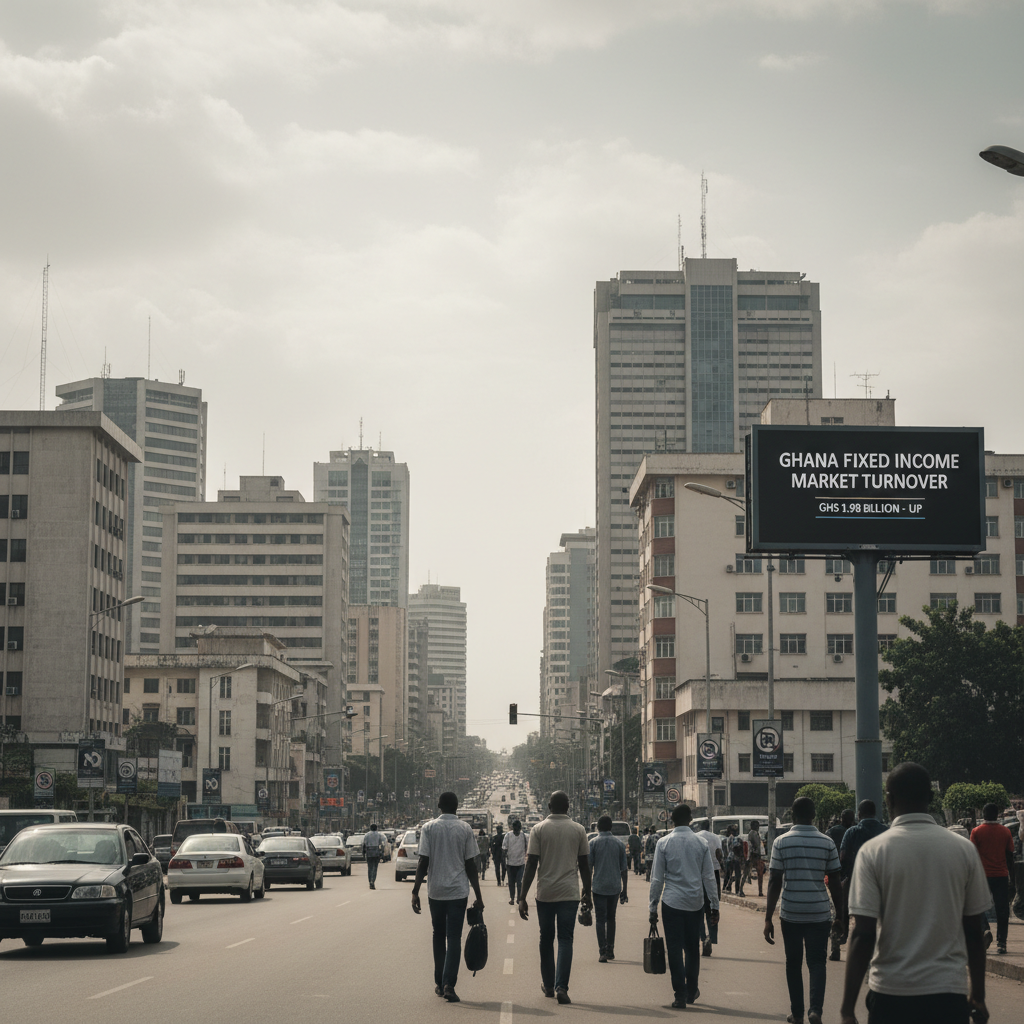
Trading activity on the Ghana Fixed Income Market (GFIM) surged to GHS 1.98 billion on Wednesday, June 26, 2024. This marked a substantial 185.08% increase from the GHS 694.61 million recorded in the previous trading session.
Treasury bills were the primary driver of this rebound, accounting for GHS 1.56 billion of the total turnover. This segment represented 78.81% of all market activity and 95.10% of the 1,878 trades executed. Investor appetite for short-dated government instruments saw a 310.71% rise in Treasury bill activity compared to the prior session.
This surge in fixed income trading highlights a persistent trend in Ghana's financial markets. Investors continue to favor short-term government securities, such as Treasury bills, due to their perceived safety and liquidity. This preference often intensifies in periods of economic uncertainty or when long-term bond yields are less attractive. The market's structure remains deeply tilted towards these short-term instruments, reflecting ongoing investor caution.
Data from the GFIM trading report confirms these shifts in market dynamics. The largest Treasury bill trade involved a GOG-BL-12/10/26-A6877-1976-0 security, which alone generated GHS 376.89 million in turnover. This single instrument represented 24.15% of the total Treasury bill trading volume, showing how value concentrates in a few specific short-dated securities. Sell-buy-back trades, which facilitate short-term financing, also returned strongly, contributing GHS 167.82 million to the overall turnover. Their reappearance suggests renewed short-term liquidity activity among market participants.
The continued strong demand for Treasury bills suggests investors prioritize liquidity and shorter duration risk. This trend is likely to persist as the market adjusts to the outcomes of the Debt Exchange Programme (DDEP). Policymakers will closely monitor this activity, as it indicates prevailing investor sentiment about Ghana's fiscal outlook. This concentration in short-term instruments could also influence the government's borrowing strategy in the coming months.
DDEP bonds, instruments issued after the recent debt restructuring, were the second-largest traded segment. They recorded GHS 242.75 million in turnover, representing 12.26% of total market activity. However, trading in DDEP bonds declined by 21.88% from the previous session's GHS 310.75 million. The largest DDEP bond trade was in the GOG-BD-10/02/32-A6148-1838-9.10 security, generating GHS 121.86 million, or 50.20% of all DDEP bond turnover. This indicates that trading in restructured bonds also remains highly focused on specific maturities. Corporate bonds saw modest activity, totaling GHS 9.05 million, a 132.12% improvement from the previous session. Yet, this segment still accounted for merely 0.46% of total market turnover, demonstrating the narrowness of Ghana's non-sovereign fixed income market. The overall market pattern underscores an enduring investor preference for government securities, especially those with shorter maturities, offering a blend of liquidity and relatively clear pricing in the current economic environment.