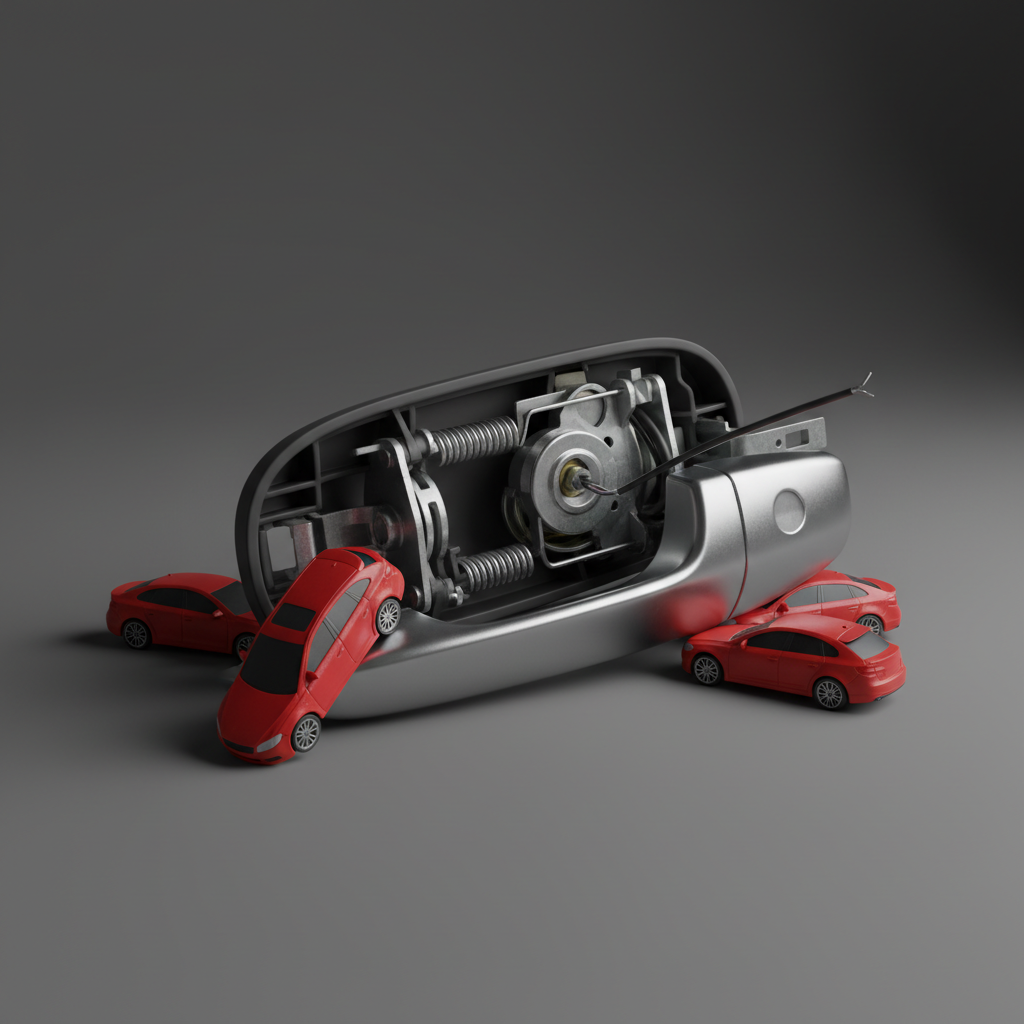
China has launched its largest-ever car recall, impacting nearly 3 million Tesla vehicles and over 1 million cars from other manufacturers. This significant action addresses safety concerns surrounding hidden door handles, which have proven difficult to operate in emergency situations.
The recall specifically targets 2.98 million Chinese-made Teslas, alongside vehicles from prominent Chinese carmakers such as XPeng, Xiaomi, and Geely. Safety experts identified that these sleek, minimalistic door designs can hinder occupants from quickly escaping a vehicle or impede rescue efforts during a crash. This issue became critical after two fatal crashes involving Xiaomi electric vehicles, where power failures reportedly prevented doors from opening.
This development fits into a broader global discussion about vehicle safety standards and design choices. While hidden door handles became a signature feature for electric vehicles, offering a streamlined aesthetic, their practical implications in emergencies are now under intense scrutiny. The Chinese government's decisive action underscores a growing regulatory focus on consumer protection within its rapidly expanding automotive market.
Tesla confirmed the recall, stating that some Model 3, Y, S, and X vehicles have door handles that are "difficult to identify and operate because their colour is similar to the interior trim." The company acknowledged that in "extreme situations such as a severe collision causing the vehicle's low-voltage system to fail, this could hinder occupants from quickly opening the doors to escape."
To address the immediate safety risks, recalled vehicles will receive a warning label affixed to the interior door. Additionally, a software update will be issued to automatically lower the windows in the event of a crash, facilitating easier exit or rescue. However, Tu Le, managing director of Sino Auto Insights, described these measures as more of a "band-aid" than a permanent solution, suggesting deeper design changes are necessary.
Looking ahead, China has already announced a ban on hidden door handles, with new rules taking effect on January 1, 2027. These regulations will mandate that all cars sold in China must feature a mechanical release on both the inside and outside of their doors. This move signals a clear shift in regulatory priorities, emphasizing functional safety over purely aesthetic considerations.
The implications extend beyond China, as US safety regulators have also investigated Tesla's door handles following reports of malfunctions. The US National Highway Traffic Safety Administration (NHTSA) is currently reviewing whether to establish new formal safety standards for emergency door-exit systems across all carmakers. This global regulatory push could lead to significant design changes across the automotive industry, impacting future vehicle models and manufacturing practices worldwide.