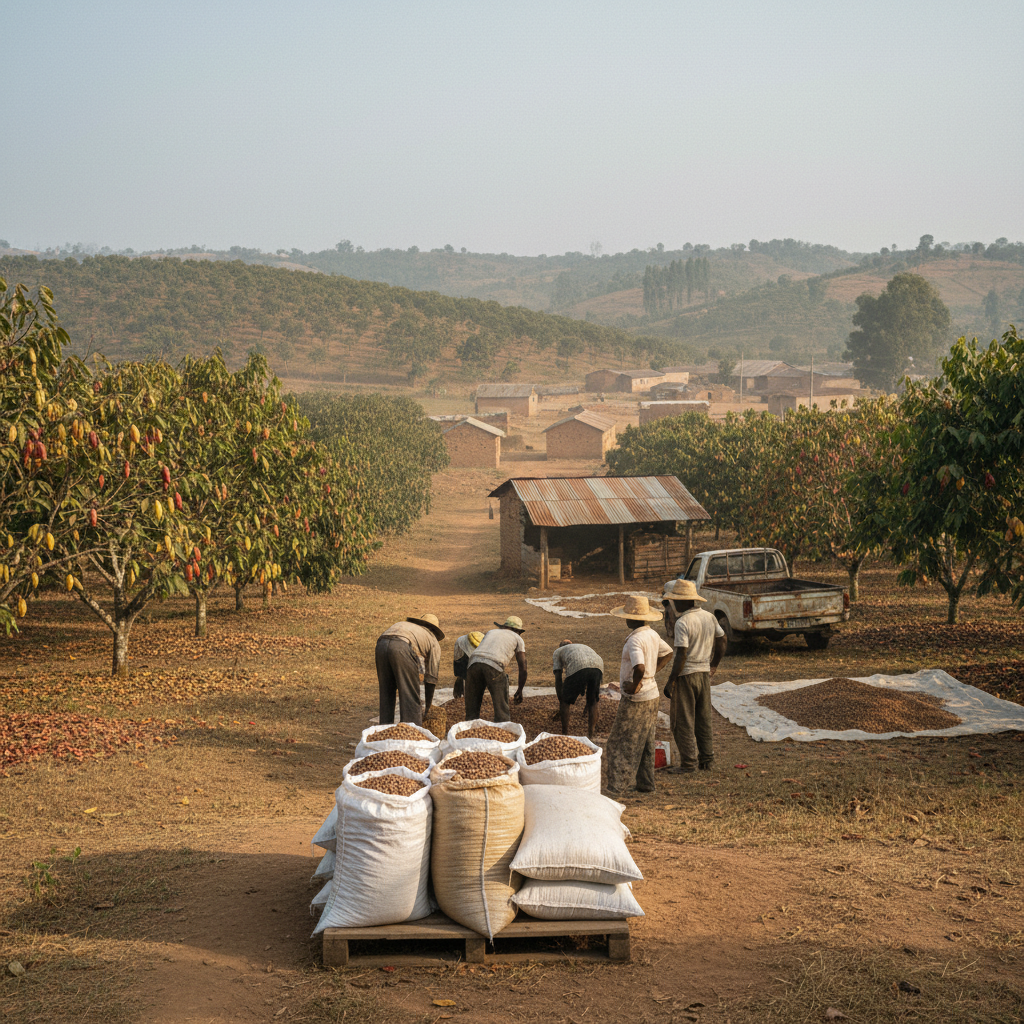
Ghana's cocoa sector faces a deepening crisis as young farmers express profound loss of confidence following significant producer price reductions and severe financing challenges. Martin Adu, convener of the Young Cocoa Farmers Association, warns that uncertainty over the new season's producer price and a lack of funds among licensed buying companies (LBCs) are undermining the industry's future.
Farmers are still recovering from a sharp reduction in the producer price during the 2025/26 season. The price began at GHS 3,625 per 64-kilogramme bag but was later cut to GHS 2,587, resulting in losses exceeding GHS 1,000 per bag for many farmers. This drastic reduction has forced some farmers to reduce essential farm maintenance, directly impacting future yields and sustainability.
This situation fits into a broader narrative of economic pressure on Ghana's agricultural backbone. Cocoa remains a vital export commodity, contributing significantly to foreign exchange earnings and supporting millions of livelihoods. However, fluctuating global prices and domestic policy challenges often leave farmers vulnerable. The current issues highlight systemic problems within the cocoa value chain, including financing mechanisms and price setting, which directly affect rural incomes and national economic stability.
“The situation where the whole thing reduced to the GHS 2,587 per bag, it's a big blow,” Adu stated on the Asaase Breakfast Show. He emphasized that farmers urgently need clarity on the new producer price, the start date for the season, and assurances of sufficient funds for cocoa purchases. Adu also highlighted widespread financing difficulties during the 2025/26 minor season, where LBCs and purchasing clerks struggled to pay farmers promptly.
The immediate implication is a potential decline in cocoa production and quality, as farmers disinvest from their farms. Decision-makers, including President John Dramani Mahama's government, must address these concerns to prevent a mass exodus of young people from cocoa farming. The stability of the cocoa sector is crucial for Ghana's economy and for the welfare of its farming communities.
Adu's concerns extend beyond immediate financial losses, pointing to a broader erosion of trust. He noted that many farmers depend on informal credit arrangements with buyers to finance labour and farm inputs. However, buyers themselves are now struggling financially, making these traditional credit lines unavailable. “As we speak, you go to the cocoa buyer, the clerks, and they even themselves, they would have wished to even come to you and then borrow from you. They don't have the money,” Adu explained.
Delayed payments have severe consequences for farming households, impacting their ability to meet essential expenses like healthcare and school fees. When harvested cocoa cannot be sold promptly, farm caretakers, who also rely on these sales for their income, suffer. This creates a ripple effect across cocoa-growing communities, exacerbating poverty and economic instability.
Adu argued that a fair producer price should exceed GHS 4,000 per bag to cover rising costs of labour, fertiliser, pesticides, and transportation. He cited expenses such as spraying farms and, in some areas, transporting water due to environmental degradation from illegal mining. The current pricing system, he believes, does not adequately reflect the true cost of production, making cocoa farming increasingly unsustainable.
The uncertainty is particularly discouraging for young people. Adu warned that if the cocoa sector is not made attractive and profitable, young farmers will not invest in their farms or remain in the industry. He noted that some young people in cocoa-growing areas are already being drawn to illegal mining due to the lack of profitability in cocoa. Providing clear information and fair prices is essential to retain the next generation of cocoa farmers and secure Ghana's cocoa future.