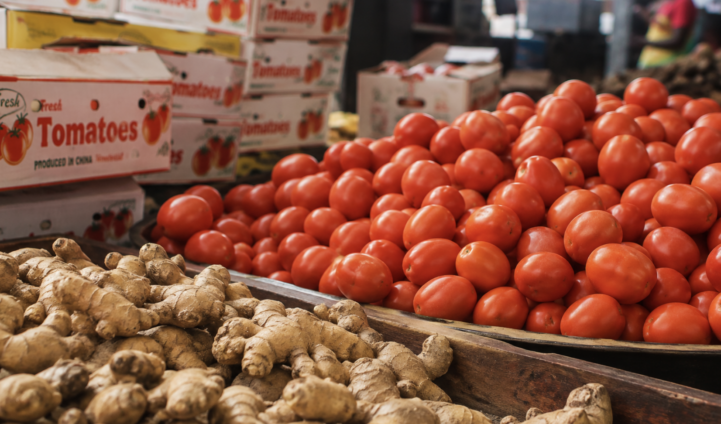
Ghana's annual tomato imports exceed GHS 2.8 billion, while a disease-driven collapse has left the country 99% dependent on imported ginger. Researchers from the Council for Scientific and Industrial Research (CSIR) highlighted these critical agricultural shortfalls, urging a research-led recovery.
The increasing reliance on imports stems from weak seed systems, limited irrigation, poor soil health, disease pressure, and insufficient investment in horticultural research. These findings were presented at the second session of the 2026 Ministry of Environment, Science, Technology and Innovation (MESTI) Visibility Webinar Series.
This situation significantly impacts Ghana's trade balance and food security, contributing to a larger import bill. The country's agricultural sector, a cornerstone of its economy, is struggling to meet domestic demand for key food items. This trend exacerbates the nation's foreign exchange challenges and underscores the urgent need for local production enhancement.
Dr. Michael Kwabena Osei, Principal Research Scientist and vegetable breeder at the CSIR Crop Research Institute, reported that national demand for fresh and processed tomatoes now exceeds 1.4 million metric tonnes annually. However, local production only meets about 15% to 18% of this requirement. He explained that Ghana produces between 120,000 and 180,000 metric tonnes of tomato per year, leaving an annual supply deficit of approximately 1.1 million metric tonnes.
Fresh tomato imports, primarily from Burkina Faso, are estimated at 100,000 to 120,000 metric tonnes annually, costing about GHS 216 million. Processed tomato imports, largely from China and Europe, are equivalent to 400,000 to 450,000 metric tonnes of raw tomato and cost about GHS 1.8 billion. Combined, tomato imports exceed GHS 2.8 billion annually, yet they only fill about 40% of the country’s total tomato shortfall.
More than 60% of fresh tomato imports enter Ghana during the dry season, from November to April, when local supply drops sharply. Despite having over 400,000 hectares of arable land suitable for tomato cultivation, Ghana’s average yield remains between seven and 10 tonnes per hectare. This contrasts sharply with potential yields of 20 to 80 tonnes under improved varieties and good agricultural management practices. Dr. Osei emphasized that the constraint is not land availability but rather a lack of technology, including quality seeds, plant protection, dry-season water, healthy soils, and sound agronomy.
He noted that about 89% of tomato farmers are small-scale growers, cultivating between five and 20 acres. Many rely on seeds extracted from ripe fruit or recycled hybrids, which lose vigor and productivity. Over 85% of tomato seeds planted in Ghana are expensive commercial hybrid seeds, highlighting the need for a stronger domestic seed system to reduce import dependence. Dr. Osei also pointed to irrigation gaps, with only about 9,000 hectares of the 15,000 hectares covered by 22 public irrigation schemes currently in use. Public irrigation schemes and affordable dry-season water are crucial for reducing imports, especially as crops can fail when temperatures rise above 32 degrees Celsius.
The tomato sector also suffers from weak extension support, acidic soils, bacterial wilt, nematodes, low organic matter, and a struggling processing industry. The state-owned Pwalugu Tomato Factory, established in 1961 with a capacity of 500 tonnes per day, has been non-functional for years. Private processors largely rely on imported concentrate instead of local fruit. The CSIR has already released two open-pollinated tomato varieties, CRI-Kwabena Kwabena and CRI-Copia, with shelf lives of approximately 18 and 21 days, respectively. The CSIR also holds the largest tomato germplasm in Ghana.
For ginger, national demand rose from about 18,000 tonnes in 2020 to between 30,000 and 32,000 tonnes in 2025. However, production collapsed after a bacterial wilt outbreak in 2022. This disease, known as the “ginger killer,” reduced national production from about 102 tonnes to roughly 10 tonnes, making Ghana more than 99% dependent on imported ginger. Ghana now spends about GHS 6 million annually importing ginger, mainly from China, Nigeria, and Burkina Faso. The supply shock has driven prices sharply upward, with a sack of ginger rising from about GHS 250 in 2022 to GHS 4,000 in 2025, and about GHS 6,000 or more at the time of the webinar.
The researchers proposed a range of interventions, including rapid evaluation of existing crop varieties, production of certified seeds, farmer training programs, establishment of solar-powered boreholes, improvements in soil quality, creation of mechanization hubs, and implementation of protected cultivation techniques. Dr. Osei also suggested Ghana needs a Tomato Board by 2028 and a dedicated Horticultural Research Institute by 2030 to coordinate research, seed development, processing, financing, and market integration. The proposed recovery framework is summarized as “policy to protect, research to solve, and market to make profit.”