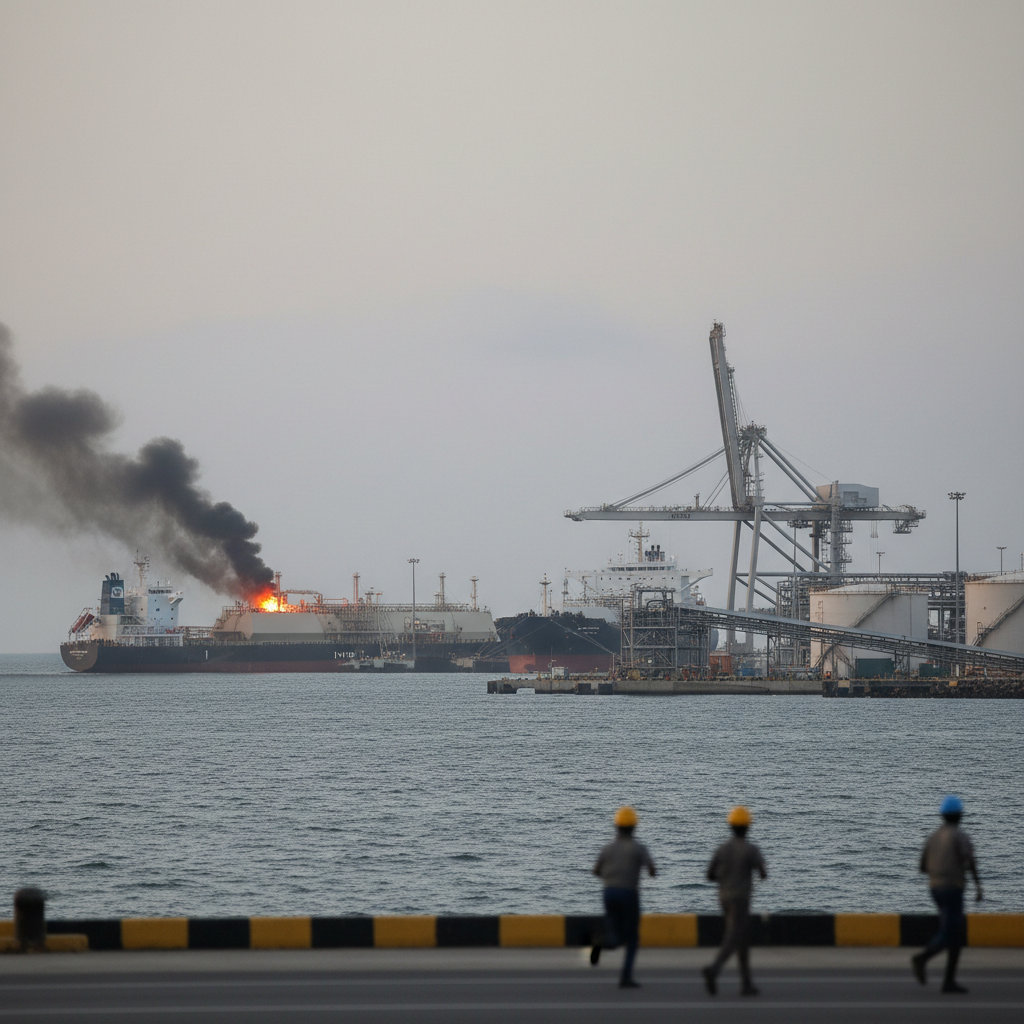
A drone attack on Wednesday caused a fire on two ships at Egypt's Mediterranean port of Damietta, a key liquefied natural gas (LNG) hub. Egypt's cabinet confirmed the incident, which involved a US-owned floating storage and regasification vessel, Energos Winter, and a Greek-owned LNG tanker, GasLog Salem. The fires were extinguished, and no casualties were reported by Egyptian authorities.
The drone reportedly struck the Energos Winter, igniting a blaze that subsequently spread to the GasLog Salem. Verified social media videos depicted thick black smoke rising from the port as tugboats worked to douse the flames. Both vessels have since left the port and moved offshore, according to ship tracking data. Egyptian authorities stated the port continued to operate at full capacity on Thursday despite the incident.
This attack occurs amidst heightened geopolitical tensions in the Middle East, particularly involving Iran and its proxies. Iranian forces and Iran-backed armed groups have previously targeted tankers and energy infrastructure in the Gulf and Red Sea. These actions have disrupted global trade routes and contributed to volatility in oil prices. The Damietta incident adds another layer of complexity to an already fragile regional security landscape.
US President Donald Trump indicated that Iran or its proxies might be responsible for the attack, stating, "It's a little more of the same. But it's going to be straightening out." This statement followed joint US and Saudi air strikes in Iraq against Iran-backed armed groups. These groups were accused of conducting 30 drone attacks on Saudi oil facilities in recent days, allegedly directed by Iran's Islamic Revolutionary Guard Corps (IRGC).
The Iraqi paramilitary Popular Mobilisation Forces (PMF), dominated by Iran-backed Shia militias, reported at least 20 members killed in the US-Saudi strikes. They condemned the actions as an "extremely serious escalation." Iran's foreign ministry also denounced the strikes and warned of "dangerous consequences." The US subsequently launched a "heavy wave of strikes" on Iran in response to an attempted missile attack on US military facilities in Jordan.
The Damietta port is crucial for Egypt's energy sector and global LNG supply chains. Any disruption at such a hub can have ripple effects on international energy markets, potentially leading to increased shipping costs and higher gas prices. Ghana, like many nations, relies on stable global energy markets, and any sustained instability could impact its import costs and overall economic stability. The incident underscores the vulnerability of critical energy infrastructure to drone attacks in volatile regions.
The ongoing investigation by Egyptian authorities aims to identify the perpetrators and prevent future occurrences. The international community will closely monitor developments, as further escalation could severely impact global trade and energy security. Decision-makers in Ghana and other importing nations will be watching for any shifts in global energy prices and supply chain reliability.