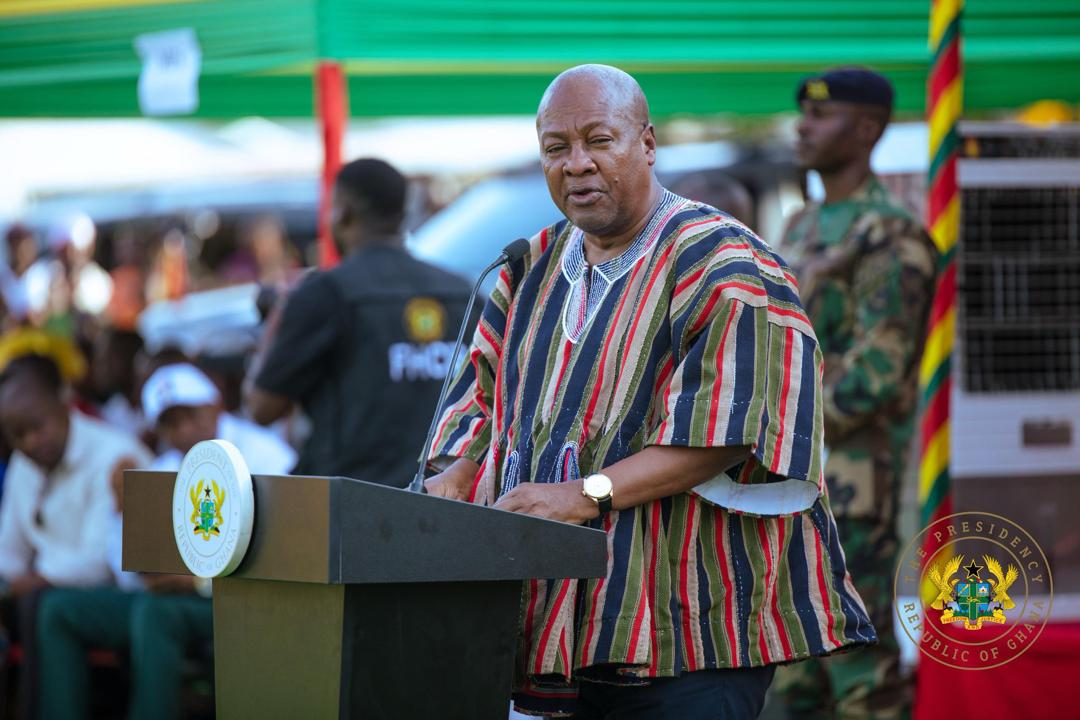
President John Dramani Mahama has announced a significant plan to establish 100,000 hectares of commercial oil palm plantations. This ambitious project falls under the government’s proposed GHS 140 billion New Economy Policy. The primary goals are to create employment opportunities and offer alternative livelihoods for young people engaged in illegal mining, commonly called galamsey.
The announcement came during a courtesy call by the Western North Regional House of Chiefs at Jubilee House. Ɔgyeahɔhoɔ Nana Yaw Gyebi II, Paramount Chief of the Sefwi Anhwiaso Traditional Area and President of the National House of Chiefs, led the delegation. President Mahama urged traditional leaders to support the initiative by making land available or establishing their own plantations. This approach aims to ensure broad participation and benefit sharing across communities.
This initiative is a critical component of Ghana's broader strategy to tackle the persistent problem of illegal mining. Galamsey has caused significant environmental damage and social challenges across the country. By providing legitimate and sustainable income sources, the government hopes to reduce the incentive for youth to engage in dangerous and destructive mining activities. This policy reflects a shift towards economic solutions alongside law enforcement efforts.
President Mahama emphasized that the project offers traditional authorities and landowners a chance to generate regular income from commercial oil palm farming. He stated, "Nananom, you are the custodians of the land. When the time comes and we are mapping and surveying where the oil palm will be grown, we are not asking you to release the land. You can also own the oil palm plantation yourselves." This statement highlights the government's intention to empower local communities economically.
The New Economy Policy, with its GHS 140 billion investment, targets job-rich sectors beyond just oil palm. The government expects these investments to create numerous jobs across various industries. This comprehensive approach aims to provide widespread economic opportunities. It seeks to deter young people from risky ventures like illegal mining by offering better alternatives.
Beyond oil palm, the government is also exploring expanding rubber cultivation in parts of the Western North Region. This move is particularly aimed at areas where cocoa yields have declined. Diversifying agricultural production helps farming communities reduce their reliance on a single crop. It provides more stable income streams for farmers and their families.
President Mahama also highlighted the newly passed Ghana Cocoa Board Act, 2026. This act guarantees cocoa farmers at least 70 per cent of international market prices. He noted that Ghanaian cocoa farmers are currently receiving 71.18 per cent, exceeding the guaranteed minimum. This measure aims to improve the profitability and sustainability of cocoa farming.
The President further updated the chiefs on planned infrastructure projects in the Western North Region. He confirmed the site for the Regional Hospital had been handed over. Procurement for a two-kilometre emergency landing airstrip and a regional sports stadium is also complete. These infrastructure developments are part of wider government plans to boost regional growth and improve public services.
The success of the 100,000-hectare oil palm project will depend on effective collaboration between the government, traditional leaders, and local communities. It also requires significant private sector investment and technical support. Monitoring the project's impact on job creation and galamsey reduction will be crucial. The policy's long-term success could offer a blueprint for sustainable economic development across Ghana.