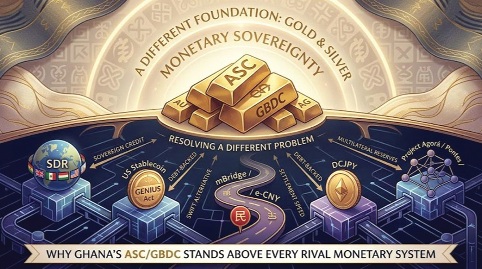
Ghana has developed a unique Asset-Backed Stable Currency (ASC) system, designed to anchor monetary value in physical gold and silver. This framework, part of the Ashanti Financial and Industrial Protocol, aims to provide a stable reserve asset independent of any single government's fiscal health or political decisions. The ASC offers a distinct alternative to the world's current monetary systems, which primarily rely on state-issued liabilities.
This Ghanaian innovation directly challenges the prevailing assumption that global money must be backed by government promises. Major global powers, including the United States, China, Japan, and Europe, are developing various digital currency and settlement systems. These include the US stablecoin strategy, China's e-CNY and mBridge, Japan's tokenised yen deposits, and Europe's Project Agorá. All these systems, however, remain fundamentally tied to sovereign fiat currencies, meaning their value depends on the issuing government's credit.
The ASC's emergence comes as the global monetary order undergoes its most significant transformation since the Bretton Woods agreement. While other nations focus on making their currencies faster or more independent from existing financial networks, Ghana's ASC addresses a deeper question. It asks what the underlying reserve asset for global money should truly be. This approach positions Ghana as a thought leader in the ongoing debate about future financial stability and independence, especially for African economies.
The International Monetary Fund's (IMF) Special Drawing Right (SDR), created in 1969, serves as a basket of major currencies. However, it lacks intrinsic value and its governance structure still under-represents Africa's economic weight. The US stablecoin strategy, formalised by the GENIUS Act, aims to defend dollar hegemony, potentially generating an estimated 1.9 trillion dollars in fresh Treasury demand by 2030. China's e-CNY, which began paying interest in January 2026, and its mBridge platform, have already settled 55 billion dollars, primarily in digital yuan, bypassing traditional systems like SWIFT. Japan's DCJPY tokenises yen deposits, while European initiatives like Agorá, Pontes, and Appia focus on making wholesale settlement programmable and near-instant. These systems, while technologically advanced, still rely on sovereign fiat currency as their foundation.
The ASC distinguishes itself by anchoring value in gold and silver, assets that have historically served as trusted stores of value across civilisations. This is not a return to the gold standard but a structural argument for a monetary system built for a multipolar, digitally settled world. Gold and silver do not carry a national flag; they are not subject to a single government's debt ceiling, five-year plans, or sanctions exposure. A nation holding ASC-denominated reserves would be less exposed to another bloc's sanctions or credit downgrades, unlike holding dollars, renminbi, or SDR claims.
Crucially, the ASC is digital by design, allowing it to combine commodity anchoring with the high settlement speeds offered by modern platforms like Agorá. It can integrate with existing digital infrastructure rather than compete against it, carrying a fundamentally different reserve asset across established digital rails. This framework is conceived from the ground up in Ghana, with African monetary sovereignty as its primary purpose. This contrasts with other global systems, which are often designed to serve the power that built them, with African participation occurring on terms set elsewhere.
The ASC does not require other systems to fail. Instead, it makes a durable claim that the reserve asset itself matters, regardless of the settlement technology used. An asset independent of any single sovereign's credit offers a more resilient foundation for global finance. This initiative could significantly enhance Ghana's economic standing and provide a model for other developing nations seeking greater financial autonomy in a rapidly evolving global economy. The long-term implications for trade, investment, and national reserves are substantial, warranting close observation by financial institutions and policymakers worldwide.