Ghana has formally applied to join the BRICS group of emerging economies. Foreign Affairs Minister Samuel Okudzeto Ablakwa announced on October 6, 2026, that Cabinet decided to pursue membership. The objective is to diversify partnerships, widen economic opportunities, and deepen cooperation with the Global South.
This application signals a strategic shift for Ghana, a middle-sized African state. The move aims to gain more room to maneuver within the global economic system. India, whose foreign minister visited Accra, has been approached to assist Ghana with its application process.
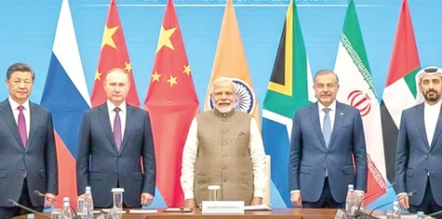
Ghana’s decision fits into a broader trend of African nations seeking diversified international engagement. BRICS, now comprising 11 states, represents about 49 percent of the world’s population. It also accounts for 39 percent of global GDP and 23 percent of international trade. This expanding economic and geopolitical weight offers Accra a platform for trade, investment, and diplomatic coalition-building. Ghana’s 2025 GDP is projected at $114.2 billion, with 6.0 percent growth, for a population of 35.1 million.
The Ghana Report highlighted that the attraction is not ideological alignment with every member. Instead, it is the opportunity to operate in a wider economic and diplomatic ecosystem. This is crucial as global power becomes more dispersed. Membership could provide another channel for engaging major emerging economies. This would reduce excessive dependence on traditional Western partners and broaden Ghana’s strategic options.
Ghana’s bid is the opening move in a significant geopolitical negotiation. Membership is not automatic; it requires political support from existing BRICS members. Accra must demonstrate its application can win consensus from Sherpas, foreign ministers, and ultimately leaders. The test is whether Ghana can convert its interest into gains without damaging longstanding relationships with the United States, European Union, and other Western partners.
The economic logic behind the application is powerful. Ghana already trades heavily with BRICS economies, particularly China and India. Ghana-China trade reached a record $14.1 billion in 2025, marking a 19.3 percent increase. In 2024, China supplied 45.9 percent of Ghana’s imports from Asia, while India supplied 13.7 percent. This concentration creates both opportunity and vulnerability for Ghana's economy.
A formal BRICS relationship could help Ghana move beyond simply buying manufactured goods and exporting raw commodities. It could support investment in processing, infrastructure, digital technology, energy, and transport. The New Development Bank, with $52.7 billion in paid-in capital, makes the prospect relevant. It supports development projects across member countries. For a country seeking infrastructure and industrial financing, engagement with the BRICS ecosystem could open additional channels of capital and development cooperation.
However, BRICS membership cannot substitute for essential economic reforms. Ghana’s debt problems, currency risks, productivity constraints, and dependence on commodities will persist. Diplomatic access does not guarantee investment. Every proposed project must still meet Ghana’s needs, affordability tests, and transparency standards. The strategic prize is enhanced bargaining power. Ghana could use closer ties with China, India, Brazil, the Gulf, and other emerging economies. This would allow it to negotiate from a broader base with Western partners. The objective should be to expand Ghana’s room for maneuver, not to replace one sphere of dependence with another. Membership can strengthen this position if Accra treats it as an instrument of diversification and strategic autonomy.
The security question is more complex. BRICS is not a military alliance and offers no collective-defense commitment. Its significance is political, providing a forum for coordinating positions on global governance and the international order. Joining would not give Ghana a BRICS security guarantee against threats like jihadist violence from the Sahel or maritime insecurity in the Gulf of Guinea. Ghana’s existing Western security relationships remain substantial. In August 2026, the Defence Ministry confirmed US cooperation included joint exercises, intelligence sharing, and counter-terrorism support. In September, Ghana reaffirmed its defence and security partnership with Washington, covering logistics, institutional development, and cyber defence. Strategic balance is essential. Accra should not allow BRICS membership to undermine interoperability with the United States, European partners, or African security institutions. The objective should be diversification, adding partnerships and markets without trading one dependency for another.
The deeper consequence is diplomatic. Ghana’s bid places it more visibly in the debate over the international system's future. BRICS advocates for stronger Global South participation and reform of global governance. A stronger voice within Global South coalitions could reinforce Ghana's calls to reform institutions whose voting structures often lag behind economic realities. This greater autonomy, however, comes with a cost, as BRICS includes nations like China and Russia.